NIP Trainees
Current NIP Trainees
2026-2027 Academic Year
Celine Ertekin: Evans Lab, Neuroscience PhD

I am a PhD candidate in the Interdisciplinary Program in Neuroscience at Georgetown University, conducting research in Dr. Rebekah Evans’ Lab. My research focuses on dissecting the neural circuits underlying movement and Parkinson’s disease, with particular emphasis on understanding how the pedunculopontine nucleus (PPN) communicates with the substantia nigra to regulate motor function and contribute to disease vulnerability. My work integrates viral circuit tracing, fiber photometry, electrophysiology, optogenetics, and advanced imaging to characterize the functional connectivity and cellular mechanisms of basal ganglia-brainstem circuits. I am currently investigating how distinct PPN neuronal populations influence vulnerable and resilient dopaminergic neuron subtypes in the substantia nigra, with the long-term goal of identifying circuit-level mechanisms that may inform future therapeutic strategies for Parkinson’s disease.
Michaela Fisher: Ostroumov Lab, Neuroscience PhD

My research focuses on understanding molecular mechanisms underlying Parkinson’s disease progression. Using a progressive animal model of Parkinson’s disease, I investigate how synaptic alterations within the substantia nigra pars reticulata may contribute to basal ganglia circuitry dysfunction, pathology development, and the emergence of Parkinsonian-like behavioral deficits. To address these questions, I employ a multidisciplinary approach that integrates in vivo and ex vivo electrophysiology, behavioral assays, and molecular biology techniques.
Caroline Francescutti: Huang Lab, Neuroscience PhD

I study disease-associated oligodendrocytes (DAOs) in the context of multiple sclerosis (MS) mouse models. I am using immunofluorescent staining, western blotting, and spatially resolved single-cell transcriptomic analysis to examine DAO formation at different MS model time-points. Further, I am testing immunomodulatory drugs in mouse models of MS to investigate whether immunomodulation alters the number or the activity of DAOs. Through this research, I aim to identify the function of DAOs to determine whether they can be a therapeutic target in neuroinflammatory conditions.
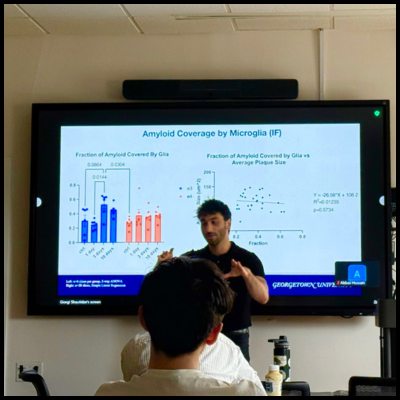
Giorgi Shautidze: Rebeck Lab, Pharmacology & Physiology PhD

I study the interaction between the immune cells of the brain and immunotherapies used in the treatment of Alzheimer’s Disease. My focus is on microglia in particular, which could be responding to these immunotherapies and potentially causing serious side effects. I utilize a multimodal approach, which spans live imaging of in vivo and ex vivo models, as well as fixed-tissue immunofluorescence assays. My lab specializes in the distinction of the APOE gene- an important indicator of sporadic Alzheimer’s Disease prevalence- and the interplay of the variant of APOE and its effect on immunotherapy treatment outcomes. With my research, I hope to contribute to a better understanding of how these drugs work in relation to the brain’s immune system and how they could further be improved to allow for wider and earlier access to these treatments.
Kaan Taskintuna: Pharmacology & Physiology PhD
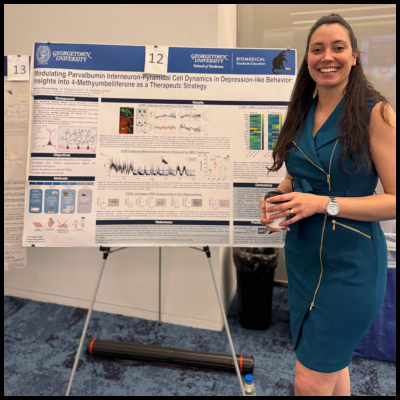
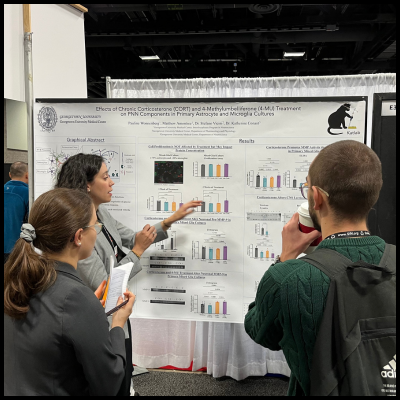
Pauline Wonnenberg: Conant Lab, Neuroscience PhD

My research investigates how chronic stress remodels the brain extracellular matrix, particularly perineuronal nets, and how these changes alter neuronal circuit function and contribute to depression-like behavior. Using behavioral neuroscience, fiber photometry, immunohistochemistry, Western blotting, and proteomics, I evaluate whether targeting the extracellular matrix with 4-methylumbelliferone can restore neural plasticity and improve stress-related behavioral outcomes. I have presented this work at national and international scientific meetings, including the Gordon Research Conference on Inhibition in the CNS and the Neurobiology of Stress Conference, and have received competitive travel and research awards to support these efforts. My long-term goal is to establish an independent research program developing extracellular matrix–targeted therapies for neuropsychiatric and neurodegenerative disorders.
Trainees in Action